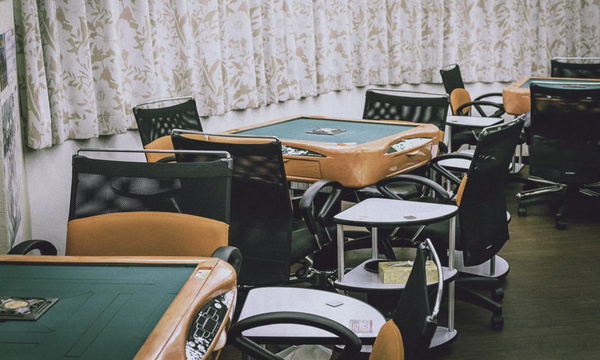
You know that feeling when your local mahjong club struggles to get girls to join but fails miserably, and yet somewhere in Japan four hot girls are seated playing a game, somewhere. These are some of the top Goddesses of Japanese Mahjong.

You know that feeling when your local mahjong club struggles to get girls to join but fails miserably, and yet somewhere in Japan four hot girls are seated playing a game, somewhere. These are some of the top Goddesses of Japanese Mahjong.

Now that I have your attention, there’s no sex. Anywhere near this post. Anyway, xkime again here. I figured I’d leave a breakdown of the “new” stats page of tenhou in here with their translation. Even better, right? … Anyway…

Becoming 6th dan in tenhou boosted my confident to teach basic strategy quite a bit. Not as much as it would if I could enter houou tables, but still quite a bit. Today will not be one of “xkime’s translations” but rather “an article actually completely wrote by xkime.” Enjoy.
Osamuko members seem to be prone to going to Japan. Deniz, ronronronronron, and now me. As some of you know, I went to Japan to play some mahjong. I’m in Amagasaki-shi right now, in Kansai. I have never been here before, but I always enjoyed playing some mahjong online or with friends, and I was pretty confident about my playstyle.
Osaka is pretty close, so I decided to stop at Marchao jansou in Umeda, a free parlor (this means, uh, betting). They very kindly explained the rules of the store to me, and made me feel really welcome. I’d recommend going there to anyone who has a good grasp of Japanese and rules and manners of mahjong. This is important. So, how did playing in Japan go?

Following the last article on Tsuchida Koushou, I want to keep introducing professional players from Japan. Today’s article features Kawamura Akihiro (川村晃裕) from the 日本プロ麻雀協会 (Japanese Professional Mahjong Association), and I actually got to make him some questions for this article.
As there are no posts for april yet, I thought I would write one, and I’d like to write about professional mahjong player Tsuchida Koushou (土田浩翔). This post will be about him.
This time I thought I wouldn’t be self-centered for the first time in a while, and make a post about something else that has gotten us a bit… excited maybe? Anyway:
CONGRATULATIONS, ASAPIN
Tile efficiency works just okay for one’s own hand, but what about the tiles that flow out? Obviously, you shouldn’t call every single one of them, but that doesn’t mean you should ignore them either. How to judge? What to consider when calling? Well, the basics are sumed up in the following text.
Be prepared to read.
You may have very well been able to understand the last pages in the original Japanese with the picture, but the following content is mainly theoric text, so unless you could understand it, you were missing on a lot.
The more I’ve been playing lately, especially on fast tables, the more I see how you need to have tile efficiency theory very in mind. Especially in nashi-nashi games, where you can’t just kui-tan your way to a full hand. So, I decided we should go on. Let’s resume from where we last left off.